You have probably heard that bicycle crunches are one of the most effective ab exercises when performed correctly. But what exactly are they doing for your body — and are you doing them in a way that actually delivers results?
The bicycle crunch is a deceptively simple movement. Done correctly, it recruits multiple core muscles at once, supports pelvic floor health, and builds the kind of functional strength that carries over into everyday life. Done poorly, it strains the neck, disengages the abs, and achieves very little.
From the muscles targeted to the most common mistakes, pelvic floor considerations, variations for every fitness level, and safety tips tailored for women — everything you need to train smarter and feel the difference.
What are the primary muscles targeted by bicycle crunch exercises?
The bicycle crunch stands out because it recruits multiple muscle groups simultaneously — making it one of the most efficient abdominal exercises you can do with zero equipment.
The rectus abdominis: your powerhouse center
The rectus abdominis is the long, vertical muscle running down the front of your abdomen — responsible for spinal flexion. It contracts every time you curl your torso forward: sitting up from lying down, bracing to lift something heavy, or bringing your elbow toward your knee during a bicycle crunch. Strengthening it improves spinal stability and reduces lower back strain over time.
The external and internal obliques: your waist definers
The obliques run diagonally along the sides of your torso. Together, they handle rotation and lateral flexion. The twisting motion that defines the bicycle crunch is almost entirely driven by these muscles. Consistent training here visibly cinches the waist and provides the lateral stability your spine needs during carrying, reaching, or sudden directional changes.
The transverse abdominis (TVA): your deep corset
The transverse abdominis is the deepest layer of your core — a built-in corset wrapping around your midsection. It generates intra-abdominal pressure that stabilizes the pelvis and lumbar spine before any limb movement begins. It works in close coordination with the pelvic floor, making it especially important for women's postural health and long-term pelvic stability.
💡 Research consistently ranks the bicycle crunch among the top exercises for rectus abdominis and oblique activation — outperforming many popular machine-based movements.
Why bicycle crunches are a game-changer for women
Core functional strength: built for real life
Every time you lift a child, carry grocery bags, or hoist a stroller, your core muscles are working. Bicycle crunches train this capacity directly — the combined flexion and rotation pattern mirrors the multi-directional demands your body faces constantly. Women who build this functional strength report less lower back tension, better posture, and greater ease with physically demanding tasks.
Postpartum recovery: with the right precautions
Before returning to any crunch-based exercise after childbirth, it is essential to check for diastasis recti — abdominal separation where the two halves of the rectus abdominis separate along the midline. Performing loaded flexion exercises before this has healed can worsen the gap. Once cleared by a healthcare provider — ideally a pelvic floor physical therapist — controlled bicycle crunches can be gradually reintroduced.
⚠️ Always consult your OB-GYN or a pelvic floor specialist before resuming core exercises postpartum.
Pelvic health: the core-floor connection
The core and the pelvic floor are deeply interconnected. Strengthening the core through exercises like the bicycle crunch contributes to better pelvic floor coordination, which may help reduce symptoms of stress urinary incontinence. However, this depends on proper coordination — poor pressure management during core work can have the opposite effect. Women with existing pelvic floor dysfunction should seek guidance from a specialist before adding crunch-based exercises.
Efficiency: maximum output, minimal time
As a compound bodyweight movement activating multiple large muscle groups, the bicycle crunch generates a high metabolic demand. It is an excellent choice for women who want to combine core strengthening and caloric burn in a single, equipment-free movement.
How to perform the perfect bicycle crunch (step-by-step)
Step 1: set your foundation
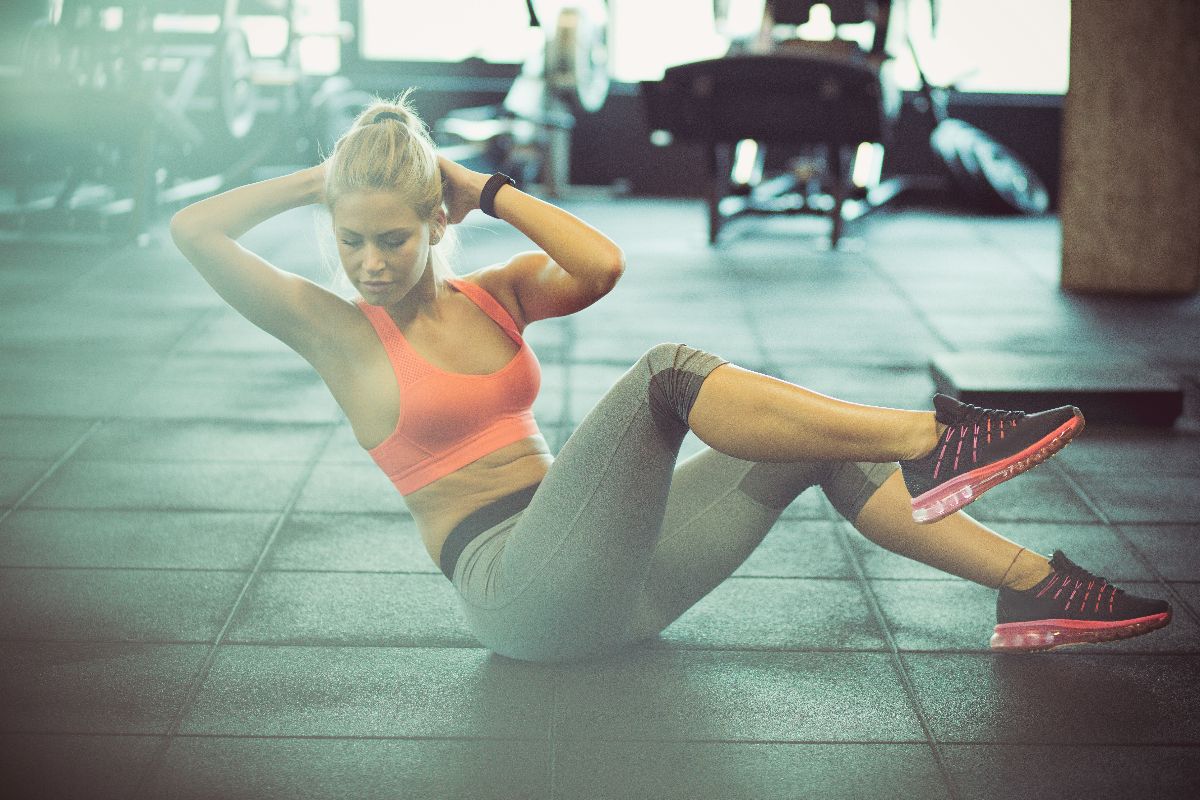
Lie flat on your back. Place hands lightly behind your head — fingertips touching, elbows wide. Bring both knees to a tabletop position. Before moving, press your lower back firmly into the mat. Every vertebra from your tailbone to your mid-back should make contact with the floor. This is non-negotiable: any arch transfers load away from the abs and onto the lumbar spine.
Step 2: the slow, controlled rotation
Extend your right leg to roughly 45 degrees while drawing the right knee in. Simultaneously, rotate your ribcage toward the bent knee — your left elbow drives the movement. Pause briefly at maximum rotation, then switch sides deliberately, as if pedaling through resistance. Aim for approximately 2 seconds per side.
Step 3: breathe with intention
Exhale fully as you rotate toward the bent knee — this deepens TVA engagement and stabilizes the core. Inhale as you transition to the opposite side. Never hold your breath: it creates excessive intra-abdominal pressure, which is particularly relevant for postpartum women or those with pelvic floor concerns.
💡 Avoid bearing down or pushing pressure outward during the movement. If you feel downward pressure in your pelvic floor, reduce intensity or modify the exercise.
Common bicycle crunch mistakes that reduce results
Pulling on your neck
When the core fatigues, the instinct is to yank the head forward with both hands. Your hands exist only to lightly support the weight of your head — they should never pull it. If you feel cervical strain, reduce range of motion before increasing reps.
Moving too fast
Fast, momentum-driven reps give the illusion of effort without the results. When you rush, the hip flexors take over and the obliques disengage. Slow down: you should feel a genuine burn in your side abs by the end of each set.
Letting the lower back arch
Once the lower back lifts off the mat, the core no longer stabilizes the spine — the lumbar muscles compensate instead. If you cannot keep your back flat while extending, raise the leg height to 60 to 70 degrees and lower it progressively as strength improves.
Holding your breath
Breath-holding reduces muscular endurance, elevates blood pressure, and increases pelvic floor pressure. Make rhythmic exhales on the twist a deliberate habit from your very first rep.
Twisting the elbows instead of the ribcage
Many people swing an elbow forward without actually rotating the torso — recruiting almost no oblique activation. The cue: your ribcage leads, not your elbow. Imagine peeling your shoulder blade off the mat as you rotate.
💡 A few slow reps in front of a mirror help you verify rotation. Watch for the shoulder — not just the elbow — visibly crossing toward the opposite knee.
Bearing down instead of lifting
If you feel pressure pushing downward rather than lifting through your core, your pelvic floor is not coordinating properly.
Can bicycle crunches make pelvic floor symptoms worse?
The bicycle crunch is a high intra-abdominal pressure (IAP) movement. When the pelvic floor is strong and well-coordinated, it responds reflexively — contracting to meet that demand. When it is weakened or poorly coordinated, that pressure can worsen symptoms: leakage, heaviness, or discomfort.
Key warning signs to watch for:
- Leaking urine during or after the movement
- A sensation of heaviness or bulging in the pelvic region
- Difficulty completing reps without breath-holding
- Persistent lower abdominal or perineal discomfort
If any of these occur, stop and consult a pelvic floor physical therapist before continuing.
How Perifit can help
One challenge with pelvic floor training is that it is invisible. Perifit changes this. Using its Kegel trainer paired with the app, Perifit gives you real-time visual feedback of your pelvic floor contractions directly on screen. Specifically, in the Biofeedback Lab, you can monitor two lines simultaneously:
- a green line tracking your pelvic floor contractions,
- a red line measuring intra-abdominal pressure.
The goal is to keep the green line high while the red line stays low. If bicycle crunches are generating too much downward pressure, you will see the red line spike — a clear signal to adjust your technique, slow your breathing, or modify the movement before symptoms appear.
Variations for every fitness level
Progress through these levels at your own pace — mastering form at each stage matters far more than rushing to the next.
| Level | Variation | Focus |
|---|---|---|
| Beginner | Dead bug — lie on your back, extend opposite arm and leg slowly while keeping the lower back flat | Learning spinal imprinting and contralateral coordination without rotation |
| Beginner | Feet-down bicycle — perform the twisting motion with both feet lightly touching the floor | Reducing hip flexor demand while building oblique activation |
| Intermediate | Standard bicycle crunch — classic movement with controlled tempo (2 seconds per side) | Full oblique, rectus abdominis, and TVA engagement |
| Intermediate | Slow-tempo bicycle crunch — 4-second rotation each side, pausing at peak contraction | Maximizing time under tension and improving mind-muscle connection |
| Advanced | Extended-leg bicycle crunch — lower leg extended to 30 degrees rather than 45 | Increased hip flexor and lower ab demand; requires strong spinal stability |
| Advanced | Weighted bicycle crunch — hold a light weight plate or medicine ball behind the head | Progressive overload for experienced practitioners with solid form |
💡 If you are postpartum or managing pelvic floor symptoms, begin at the beginner level regardless of your general fitness. The neuromuscular reconnection process takes time.
Safety tips & modifications of bicycle crunches for women
Protecting the lower back: anterior pelvic tilt
Anterior pelvic tilt — where the pelvis tips forward causing excessive lumbar arch — is common in women who sit for long hours or have weakened glutes. When this posture carries into floor exercises, load shifts from the abs to the lumbar spine.
If this applies to you:
- Before starting, perform a posterior pelvic tilt: press your lower back into the mat without forcing excessive posterior pelvic tilt or gripping glutes, and draw your navel gently inward. Hold this throughout.
- Keep the extended leg higher (60 to 70 degrees) until core strength allows lower angles.
- Incorporate hip flexor stretching and glute strengthening alongside core work.
- Consider working with a physical therapist to assess pelvic alignment before progressing.
Pregnancy modifications: when to stop supine exercise
During the first trimester, most women can continue supine exercise without concern. From approximately 20 weeks onwards, lying flat is generally not recommended — the growing uterus can compress the inferior vena cava, reducing circulation and causing dizziness.
Suitable substitutes:
- Seated rotations
- Standing oblique crunches
- Side-lying leg lifts
The quality over quantity rule
Twenty slow, controlled, fully engaged bicycle crunches consistently outperform one hundred rushed reps — in muscle recruitment, injury prevention, and long-term progress. When form breaks down, the targeted muscles disengage and the neck, hip flexors, and lower back compensate.
A practical approach: stop each set the moment your form deteriorates. Rest, reset, and perform another quality set. Progress comes from the reps done well — not from the total count.
The bicycle crunch earns its reputation as one of the most effective core exercises available. It simultaneously targets the rectus abdominis, obliques, and transverse abdominis — building the functional strength, waist definition, and deep core stability that matter for women at every stage of life.
The difference between results and frustration comes down to execution. Slow the movement down, lead with your ribcage, keep your lower back grounded, and breathe with intention. Start at the variation that matches your current level and progress deliberately.
If you are postpartum, managing pelvic floor symptoms, or pregnant, adjust accordingly — and do not hesitate to work with a pelvic floor specialist or use a tool like Perifit to make sure your deep core is truly doing the work. A strong, well-coordinated core is one of the most valuable investments you can make in your long-term health.
Sources: